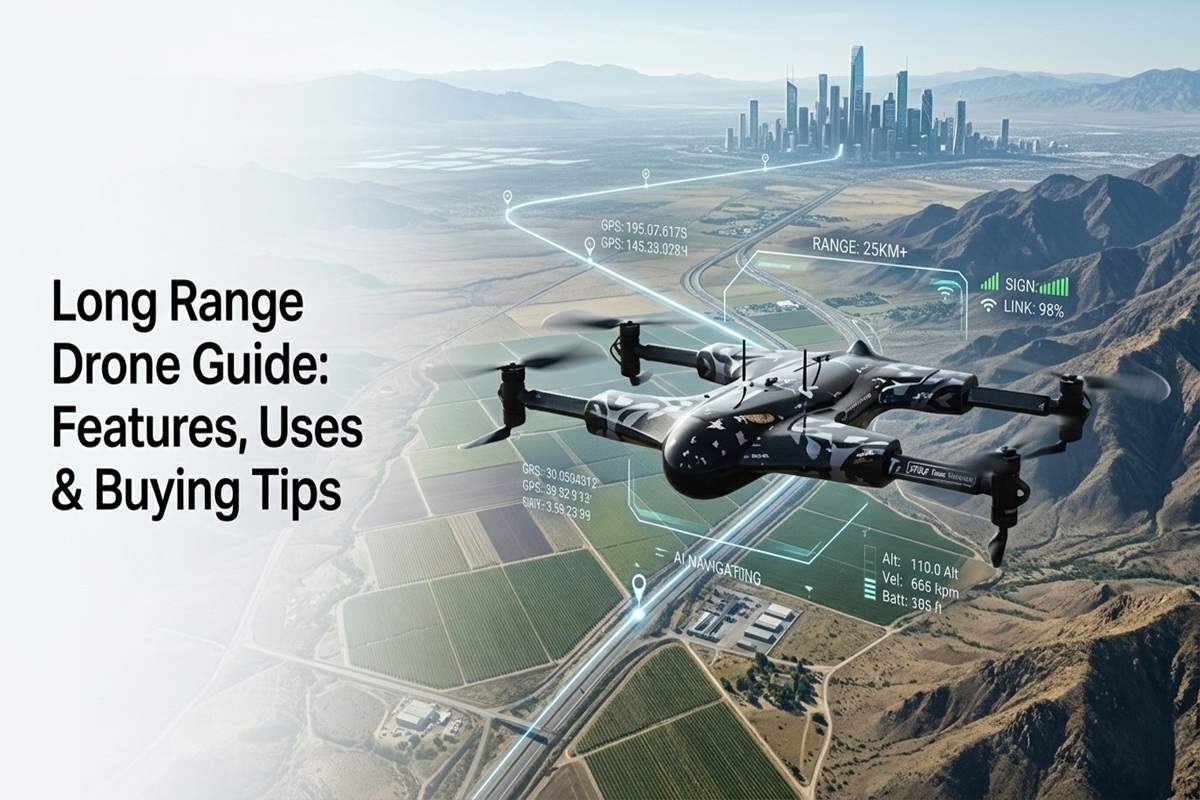
The rapid advancement of drone technology has transformed industries ranging from agriculture and logistics to filmmaking and infrastructure inspection. Among the most sought-after innovations is the Long Range Drone, a category of unmanned aerial vehicles designed to travel significantly farther than conventional consumer drones.
Whether you're a business owner looking to improve operational efficiency, a professional pilot conducting aerial surveys, or a technology enthusiast exploring advanced UAV capabilities, understanding long-range drone technology is essential. These drones provide extended coverage, greater flexibility, and enhanced data collection capabilities that make them valuable across numerous applications.
In this comprehensive guide, we'll explore how long-range drones work, their benefits, key features, real-world applications, and how to choose the right model for your needs.
A Long Range Drone is an unmanned aerial vehicle engineered to maintain stable communication and flight performance over extended distances. While standard consumer drones may offer flight ranges of 2 to 10 kilometers, advanced long-range systems can exceed 20, 50, or even 100 kilometers under suitable conditions and regulatory approvals.
The actual Drone Flight Range depends on multiple factors, including:
Long-range drones often utilize advanced transmission systems, GPS navigation, autonomous flight modes, and high-capacity batteries to achieve extended operational distances.
The demand for long-distance aerial operations continues to grow worldwide. Organizations are increasingly investing in drones that can cover larger areas without requiring frequent repositioning or battery changes.
Several factors are driving this trend:
As drone technology matures, businesses are recognizing the cost savings and operational advantages of deploying long-range systems.
Not all drones are designed for extended-distance operations. The following features distinguish a true long-range platform from standard recreational models.
Reliable communication is critical for maintaining control at extended distances.
Modern drones use:
These systems help maintain stable video feeds and command links even over substantial distances.
Battery technology directly impacts flight endurance.
Many long-range models feature:
Some professional systems can remain airborne for over one hour, while specialized fixed-wing UAVs may achieve several hours of flight time.
Accurate positioning enables safe operation across large areas.
Features often include:
These capabilities improve reliability and reduce operational risks.
Many long-range drones serve as data collection platforms.
Common payloads include:
These tools enable valuable insights for commercial users.
Organizations and professionals choose long-range drones because they deliver measurable advantages over conventional UAVs.
One of the biggest benefits is the ability to monitor large geographic regions during a single mission.
Examples include:
This reduces operational time and labor costs.
Extended flight capabilities minimize the need for:
As a result, teams can complete projects faster and more efficiently.
Long-range platforms capture comprehensive datasets that improve analysis and decision-making.
Applications include:
Certain environments are difficult or dangerous for personnel to access.
Long-range drones can safely inspect:
Although the initial investment may be higher, businesses often achieve significant long-term savings through automation and reduced manpower requirements.
The capabilities of a Long Distance UAV make it suitable for a wide range of industries.
Precision agriculture relies heavily on aerial intelligence.
Long-range drones help farmers:
Large farms particularly benefit from extended coverage capabilities.
Utility companies use drones to inspect:
Instead of sending crews across vast areas, operators can complete inspections remotely.
Surveyors use drone-generated data to create accurate maps and models.
Applications include:
Emergency response agencies deploy drones for:
Long-range capabilities can dramatically improve response effectiveness.
Drone delivery remains one of the most promising applications for long-distance operations.
Several companies worldwide are testing delivery systems capable of transporting medical supplies, packages, and essential goods over significant distances.
When evaluating the Best Long Range Drones, several categories stand out.
Popular options include:
These drones offer impressive transmission ranges, advanced imaging capabilities, and intelligent flight features.
Professional organizations often select:
These platforms support industrial payloads and enterprise-level operations.
For maximum distance and endurance, fixed-wing UAVs are frequently preferred.
Advantages include:
These systems are commonly used for mapping, defense, and environmental monitoring.
Choosing the right drone requires careful evaluation of operational requirements. This Long Range Drone Buying Guide highlights the most important considerations.
Ask yourself:
The intended application will determine the required specifications.
Avoid paying for capabilities you don't need.
Consider:
Always compare real-world performance rather than relying solely on manufacturer specifications.
Flight time often matters more than advertised range.
Look for:
Longer endurance generally improves operational productivity.
Commercial users should verify compatibility with:
Payload flexibility enhances future scalability.
Critical safety functions include:
These features reduce operational risks and equipment losses.
Drone regulations vary by country and region.
Before purchasing, ensure compliance with:
Compliance is especially important for commercial operations.
The market for Commercial Long Range Drones is expanding rapidly as organizations seek efficient methods of collecting aerial data and performing remote inspections.
Businesses should focus on:
Enterprise-grade systems often include cloud-based analytics, fleet management tools, and advanced mission planning software that improve operational effectiveness.
When properly integrated into workflows, commercial long-range drones can deliver significant returns on investment through increased productivity and reduced operational costs.
Several innovations are shaping the future of the drone industry.
Key developments include:
Industry analysts predict substantial growth in commercial drone adoption over the coming decade, driven by improvements in battery technology, connectivity, and automation.
A Long Range Drone offers far more than extended flight distance. It provides enhanced efficiency, wider coverage, improved data collection, and greater operational flexibility for both recreational and commercial users. As industries increasingly embrace aerial technology, long-range platforms are becoming essential tools for surveying, agriculture, infrastructure inspection, public safety, and logistics.
By understanding key specifications, evaluating mission requirements, and following a practical purchasing strategy, buyers can confidently select the right solution. Whether you're researching the Best Long Range Drones, exploring Commercial Long Range Drones, or comparing Drone Flight Range capabilities, investing in the right platform can unlock significant value and long-term performance benefits.
A long-range drone is typically a UAV capable of flying beyond 10 kilometers while maintaining stable communication and navigation systems. Professional models may exceed 50 kilometers or more under optimal conditions.
The primary factors include battery capacity, signal transmission technology, weather conditions, terrain obstacles, antenna quality, and aircraft design.
Drone regulations vary by country. In many regions, pilots must comply with registration requirements and may need special authorization for Beyond Visual Line of Sight (BVLOS) operations.
Agriculture, surveying, infrastructure inspection, public safety, environmental monitoring, mining, and logistics are among the industries that gain significant advantages from using a Long Distance UAV.
Start by identifying your primary use case, required flight range, payload needs, battery endurance expectations, safety features, and local regulatory requirements. Following a structured Long Range Drone Buying Guide can help ensure the right investment.

This post has been authored and published by one of our premium contributors, who are experts in their fields. They bring high-quality, well-researched content that adds significant value to our platform.